



Dirty Politics and Bad Faith Judgments

Luke 12: 2 to 3
Nothing is covered up that will not be revealed, or hidden that will not be known. 3 Therefore whatever you have said in the dark shall be heard in the light, and what you have whispered in private rooms shall be proclaimed on the housetops.
Being unhoused is a condition, not a conviction
The streets are full of people needing help, not handcuffs
Compassion declines when hardship is mistaken for criminality

Welcome Back: Looking Behind the Curtain
Thank you for joining us once again as we continue this important discussion on homelessness, public policy, and the narratives that shape our understanding of one of the most vulnerable populations in America.
Throughout this series, we have challenged ourselves to look beyond the headlines and political talking points. In our first blog, we explored what appears to be a system increasingly designed to produce failure rather than meaningful solutions. We examined how policies, bureaucracy, and shifting priorities often leave struggling individuals trapped in circumstances they cannot easily escape.
In the second installment, we briefly examined many of the root causes of homelessness. We looked at issues such as housing shortages, inflation, medical emergencies, mental health struggles, addiction, family breakdown, rising costs of living, and the many unforeseen events that can push a person from stability into crisis. While every homeless person’s story is unique, one truth remains constant: homelessness rarely occurs because of a single event. More often, it is the result of multiple failures converging at the same time.
Introduction
Today, we move even deeper into the conversation.
This discussion may be uncomfortable at times. Some of the questions raised may challenge assumptions we have held for years. That is intentional. Real solutions are rarely found by avoiding difficult questions. They are found by honestly examining what is happening, testing what we are being told, and refusing to accept convenient explanations without scrutiny.
We live in an age where information is abundant, yet genuine understanding can be surprisingly scarce. Narratives are crafted, stories are repeated, and over time those stories begin to shape how entire groups of people are viewed. Eventually, perceptions become accepted as facts, whether they are fully accurate or not.
The homeless population has become one of those groups.
Many people have formed opinions about homelessness without ever speaking to a homeless person. Others have relied solely upon news reports, political statements, social media commentary, or carefully selected statistics. While each of these sources may contain elements of truth, they rarely tell the entire story.
The purpose of this blog is not to excuse bad behavior, deny legitimate problems, or pretend that challenges do not exist within the homeless population. There are real issues. There are individuals struggling with addiction. There are those suffering from severe mental illness. There are people who make poor decisions and refuse assistance.
However, there are also veterans, senior citizens, working families, disabled individuals, victims of domestic violence, young adults aging out of foster care, and countless others who simply found themselves overwhelmed by circumstances they could not overcome alone.
The question before us is simple:
Are we seeing the complete picture, or only the portion of the picture that others want us to see?
As we move through this installment, we invite you to think critically, ask questions, and evaluate the information for yourself. Do not simply accept our conclusions. Test them. Research them. Challenge them. Verify them.
If we are wrong, then you lose nothing by investigating further.
If we are right, then perhaps it is time to reconsider some of the assumptions that have quietly shaped public opinion regarding homelessness for far too long.
The stakes are higher than many realize. Public opinion often becomes public policy, and public policy eventually affects real people. The decisions being made today will influence whether vulnerable men, women, and children receive compassion, opportunity, and assistance—or whether they are increasingly viewed as problems to be removed from public sight.
With that in mind, let us continue our journey behind the curtain and examine some of the narratives, assumptions, and policies that are shaping the future of homelessness in America

Choosing What Is Seen—and What Is Not Seen
Without thinking too hard about it, what image immediately comes to mind when you hear the phrase, “homeless person arrested”?
For many people, the image is not flattering. It is often someone dirty, disheveled, unwashed, carrying everything they own, standing in handcuffs while police officers escort them away. It is a picture that has been repeated so often through news reports, television programs, social media, and political messaging that it has become the default image in our minds.
But have you ever stopped to ask why?
Why is that the image we see first?
Why do we not picture the elderly grandmother who lost her apartment after a rent increase? Why do we not picture the veteran sleeping in his car after exhausting every resource available to him? Why do we not picture the working family living in a motel room because inflation consumed every dollar they earned?
The answer may be uncomfortable.
Narratives are powerful. They shape perceptions, influence emotions, and eventually guide public policy. When a particular image is repeated enough times, it begins to represent the entire group, regardless of whether it accurately reflects reality.
That is exactly what has happened with homelessness.
We are attempting to swim upstream against a narrative that has been carefully crafted for years. It is a difficult task because those promoting the narrative possess significant resources, influence, and access to media platforms. The average citizen sees only what is placed before them and rarely has the opportunity to look deeper.
The reality is that homelessness is far more complex than the picture being painted.
Yes, there are individuals who struggle with addiction.
Yes, there are individuals who struggle with severe mental illness.
Yes, there are individuals who make poor choices.
But there are also people who have been priced out of housing, overwhelmed by medical debt, devastated by inflation, abandoned by support systems, displaced by redevelopment projects, and failed by institutions that were created to help them.
Yet these stories rarely receive equal attention.
The challenge before us is learning to separate the individual from the stereotype.
A homeless person is not simply a statistic.
They are not merely a policy problem.
They are not a nuisance to be managed.
They are human beings.
The danger of accepting a one-dimensional narrative is that it slowly erodes our compassion. Once compassion begins to disappear, it becomes easier to justify increasingly harsh solutions. What would have seemed unacceptable ten years ago suddenly becomes reasonable today because we have been conditioned to view the homeless as a threat rather than people in need.
This process rarely happens overnight.
It occurs slowly.
One news story.
One policy.
One ordinance.
One executive order.
One social media post at a time.
Like ice melting in the spring, the change often goes unnoticed until the damage is already done.
The homeless population certainly has challenges. No honest discussion can deny that reality. However, should the failures of some become the condemnation of all?
That is the question we should be asking.
Hundreds of thousands of Americans experience homelessness each year. Are we willing to judge every one of them by the actions of the most visible and troubled among them? Are we willing to accept broad assumptions because they are convenient?
Or should we be demanding a more complete picture?
The scales are being tipped, and when scales are tipped long enough, eventually people begin to mistake imbalance for truth.
That is why it is so important to challenge assumptions, ask questions, and refuse to allow any vulnerable group to be reduced to a caricature.
The homeless deserve the same consideration we would want for ourselves if circumstances ever placed us in their position.

Admitting Failure Only When Convenient
One of the greatest challenges facing our nation today is the increasing reluctance to admit failure.
Failure is no longer viewed as an opportunity for correction. Instead, it is often hidden, redirected, explained away, or blamed on someone else.
Nowhere is this more visible than in the discussion surrounding homelessness.
For decades, billions of dollars have been allocated through federal, state, county, municipal, and nonprofit programs designed to address homelessness. Grants have been awarded. Initiatives have been launched. Committees have been formed. Strategic plans have been written. Conferences have been held. Reports have been published.
Yet homelessness continues to grow.
The obvious question should be simple:
Why?
Unfortunately, asking that question has become increasingly uncomfortable.
When programs fail to achieve their intended goals, accountability should follow. Honest evaluations should be conducted. Weaknesses should be identified. Strategies should be revised. Leadership should acknowledge mistakes and seek better solutions.
Instead, something very different often occurs.
The blame begins to shift.
Rather than examining failed systems, failed policies, or failed leadership, attention gradually turns toward those experiencing homelessness themselves.
The narrative becomes that homelessness exists because homeless people refuse help.
Homelessness exists because they made poor choices.
Homelessness exists because they are unwilling to work.
Homelessness exists because they are addicted.
Homelessness exists because they are mentally ill.
While each of these factors may contribute in individual cases, none adequately explain the magnitude of the crisis we are witnessing today.
A housing shortage is not created by homeless people.
Inflation is not created by homeless people.
Skyrocketing rents are not created by homeless people.
Escalating utility costs are not created by homeless people.
Medical debt is not created by homeless people.
The disappearance of affordable housing is not created by homeless people.
Yet somehow the burden of blame increasingly falls upon the very people most affected by these realities.
Accountability has become a disappearing virtue in many areas of society. Good leadership accepts responsibility. Poor leadership searches for scapegoats.
History repeatedly demonstrates that when systems fail, leaders often seek someone weaker to blame. The vulnerable become convenient targets because they possess little political influence and few resources to defend themselves.
The homeless population fits that description perfectly.
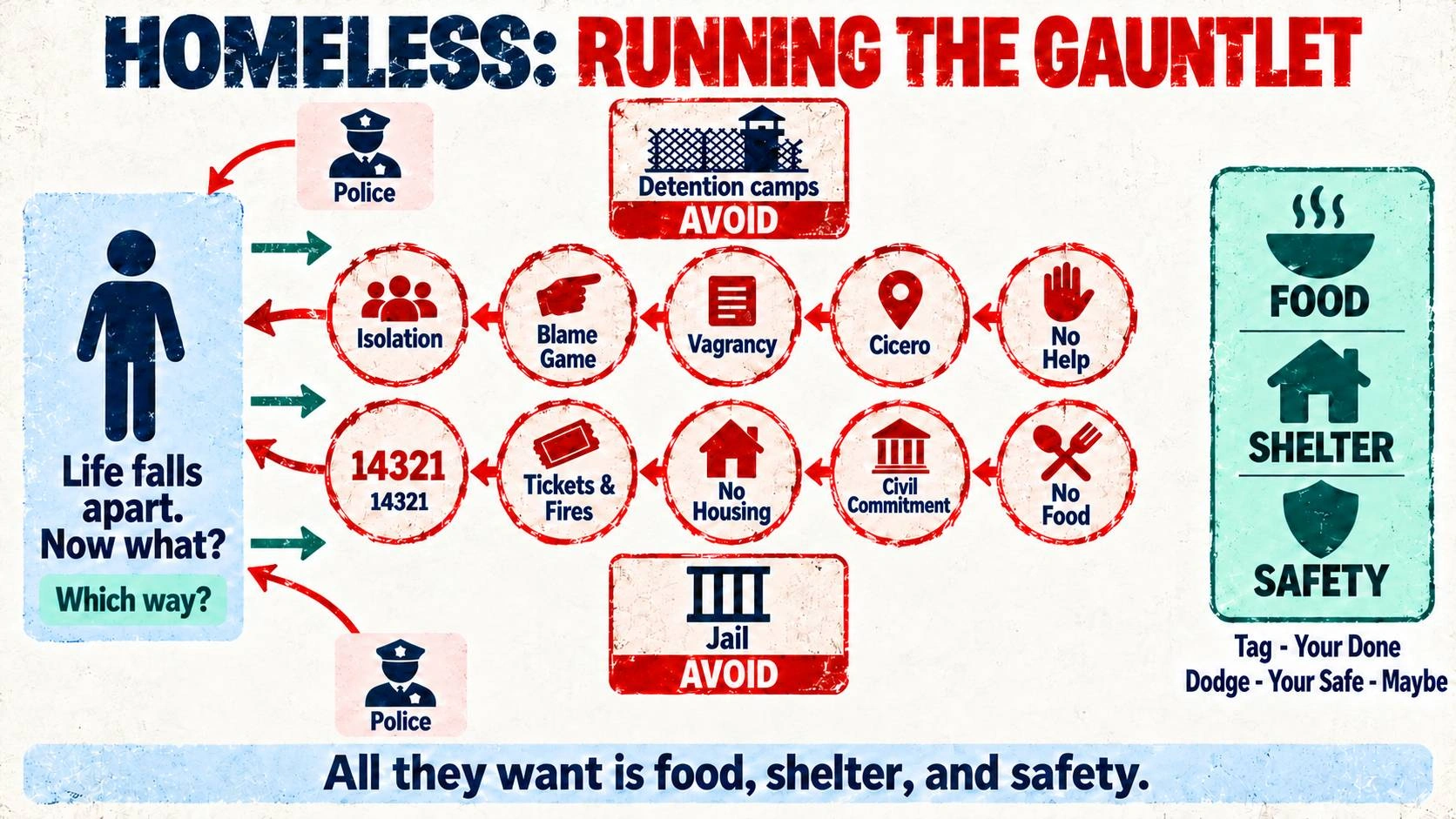
As public frustration rises, policies become more punitive. Tickets are issued. Camps are swept. Ordinances multiply. Restrictions increase. Enforcement expands.
Meanwhile, the underlying causes often remain untouched.
This creates a troubling cycle.
The homeless are blamed for conditions they did not create.
Punitive measures are implemented.
The conditions worsen.
More blame follows.
And the cycle repeats itself.
Perhaps the most concerning aspect of this pattern is that it allows institutions to avoid confronting their own shortcomings.
If homelessness is always the fault of the homeless, then no one else is responsible.
No policies need to be reevaluated.
No leadership decisions need to be questioned.
No failed programs need to be examined.
The problem conveniently becomes the people rather than the system.
That may be politically useful, but it is not a solution.
Real solutions begin with honest assessments.
They begin when leaders are willing to acknowledge what has not worked.
They begin when citizens demand accountability from those entrusted with resources and authority.
Most importantly, they begin when we stop treating homeless individuals as the cause of every problem and start recognizing that many of them are living with the consequences of problems they never created.
Failure should never be hidden behind a convenient narrative.
It should be confronted honestly so that genuine solutions can finally emerge.

Leaving the Back Door Open and Its Problems
Few issues in recent American history have generated as much debate as immigration and border security. Depending upon where one stands politically, it is either viewed as a humanitarian necessity, a national security concern, or some combination of both. Regardless of political affiliation, however, one reality remains: significant population growth places pressure on existing systems and resources.
When discussing homelessness, many people are hesitant to connect these issues. Yet it is difficult to discuss housing shortages, strained public resources, and rising demand without acknowledging the impact that population increases can have on local communities.
A nation has both the right and the responsibility to manage its borders in a way that protects its citizens while maintaining an orderly immigration process. America has long been a nation of immigrants. Our history is filled with stories of individuals who arrived seeking freedom, opportunity, and a better life. Those stories are part of what makes this nation unique.
However, immigration has traditionally been governed by laws, procedures, and systems designed to balance opportunity with stability.
When those systems become overwhelmed, consequences begin to appear throughout society.
Housing demand increases.
Public services become stretched.
Community resources become strained.
Local governments struggle to keep pace.
The effects are often felt most severely by those who were already living on the edge of survival.
The homeless rarely possess the financial resources necessary to compete in a tightening housing market. They do not have savings accounts, investment portfolios, or emergency reserves. They live one setback away from disaster, and many are already living within the disaster itself.
When housing becomes scarce, those with the least resources lose first.
When rental prices rise, those with the least income suffer first.
When assistance programs become overwhelmed, those with the fewest alternatives fall through the cracks first.
These realities do not require political allegiance to recognize. They are simply the consequences of supply, demand, and limited resources.
The tragedy is that discussions surrounding these issues often become so politically charged that honest conversations become nearly impossible. One side refuses to acknowledge the strain that rapid population growth can place on communities. The other side sometimes overlooks the humanitarian realities that drive migration in the first place.
Lost between these competing arguments are the vulnerable people already struggling within the system.
The homeless rarely have lobbyists advocating for them.
They rarely have large organizations defending their interests.
They rarely receive media attention unless they become part of a larger political story.
As a result, their needs are often overlooked while larger battles dominate public discussion.
The question is not whether immigration should exist. America has always welcomed newcomers and will likely continue to do so.
The question is whether policymakers honestly considered the impact their decisions would have on housing availability, social services, public resources, and those already struggling to survive.
When difficult questions are ignored, difficult consequences often follow.
The homeless did not create the housing crisis.
They did not create inflation.
They did not create shortages.
Yet they often bear the consequences of all three.
Whether one agrees or disagrees with past policies, the result is visible in communities across the nation. Housing has become less affordable. Resources have become more strained. Vulnerable populations face increasing competition for assistance.
These realities deserve honest examination rather than political slogans.
Solutions will never emerge from denial.
They emerge when we are willing to acknowledge every factor contributing to the problem, even those that make us uncomfortable

Orchestrating the Grand Puppet Show
If we are willing to slow down for a moment, step back from the noise, and honestly observe what is happening around us, we may discover that we have spent years watching what resembles a carefully managed puppet show.
That may sound harsh, but consider the possibility.
Every day we are bombarded with information. News broadcasts, social media feeds, government statements, political commentary, expert opinions, and endless headlines compete for our attention. Most of us are busy trying to work, raise families, pay bills, and survive our own challenges. We simply do not have the time to investigate every claim that is presented to us.
As a result, we often trust others to interpret reality on our behalf.
That trust can be beneficial when exercised responsibly.
It can also be dangerous when abused.
The power to shape public opinion has always been one of the most valuable forms of influence. If you can determine what people see, what they hear, and how they interpret events, you can often influence what they believe.
Homelessness is no exception.
For years, the public has been presented with a steady stream of stories emphasizing the most visible and troubling aspects of homelessness. Encampments. Crime. Addiction. Mental illness. Public disorder. Emergency responses. These issues certainly exist and should not be ignored.
However, what is often missing from the conversation are the stories that reveal the broader picture.
The grandmother choosing between medicine and rent.
The veteran navigating a broken support system.
The worker whose paycheck no longer covers basic necessities.
The family living in a vehicle after a medical crisis.
The senior citizen displaced by rising housing costs.
These stories rarely dominate headlines because they do not fit the preferred narrative.
Fear captures attention.
Conflict generates clicks.
Compassion requires reflection.
One is easier to market than the other.
As a result, public perception gradually shifts. The homeless cease being viewed as people facing hardship and begin being viewed as a public problem requiring management.
The language changes.
Words are softened.
Definitions are altered.
Policies are renamed.
Programs are rebranded.
What once would have sparked concern is presented as common sense.
This is how narratives gain power.
Not through a single dramatic event but through thousands of small messages repeated over time.
The danger lies not in receiving information but in receiving only one side of the information.
When citizens are presented with incomplete pictures, they often arrive at incomplete conclusions.
This is why critical thinking remains essential.
It is why asking questions remains important.
It is why citizens should examine policies based not only upon what is promised but also upon the outcomes being produced.
If a strategy claims to reduce homelessness but homelessness continues to increase, questions should be asked.
If billions are spent and conditions worsen, questions should be asked.
If vulnerable populations continue to suffer despite endless promises of reform, questions should be asked.
The goal is not cynicism.
The goal is accountability.
Healthy societies depend upon informed citizens willing to look beyond the headlines and examine reality for themselves.
When we stop asking questions, the puppet strings become easier to hide.
When we start asking questions again, those strings often become impossible to ignore.
The challenge before us is simple: look carefully, think independently, and refuse to surrender your judgment to those who may benefit from controlling the narrative.
The homeless deserve nothing less than an honest examination of the facts surrounding their circumstances.
And the American people deserve nothing less than the truth.

A Circumstantial Case
Imagine for a moment that you are sitting in a courtroom.
Evidence is being presented.
Witnesses are speaking.
Documents are being submitted.
Arguments are being made.
As the judge, your responsibility is not to react emotionally. Your responsibility is to examine the facts carefully and determine whether the case being presented actually supports the conclusions being sought.
Now let us apply that same standard to the discussion surrounding homelessness.
Increasingly, the public is being presented with a narrative suggesting that homelessness is primarily the result of addiction, mental illness, personal irresponsibility, and refusal to accept help.
Those factors certainly exist.
The question is whether they explain the entire problem.
Or are we being presented with only part of the evidence?
Let us consider the information.
Homelessness has increased significantly since the pandemic years. Communities across the nation have reported growing numbers of individuals struggling to secure housing.
Senior citizens represent one of the fastest-growing segments of the homeless population.
Working individuals are increasingly finding themselves unable to afford housing despite maintaining employment.
Families are living in vehicles, motels, and temporary arrangements because affordable options have disappeared.
These realities complicate the simplistic narrative that homelessness is solely the result of personal failure.
Now let us examine addiction and mental illness.
Substance abuse is unquestionably a factor within portions of the homeless population.
Mental illness is unquestionably a factor within portions of the homeless population.
However, even the available statistics demonstrate that neither category encompasses all homeless individuals.
Yet many policies, public statements, and media narratives increasingly treat homelessness as though addiction and mental illness are universal characteristics.
That assumption matters.
Why?
Because the proposed solutions often flow directly from the assumptions being made.
If homelessness is viewed primarily as an addiction problem, treatment becomes the preferred solution.
If homelessness is viewed primarily as a mental illness problem, involuntary commitment becomes the preferred solution.
If homelessness is viewed primarily as criminal behavior, law enforcement becomes the preferred solution.
But what happens when homelessness is actually a housing problem?
Or an inflation problem?
Or a medical debt problem?
Or a fixed-income problem?
Or a senior citizen problem?
Or a workforce affordability problem?
Suddenly the solutions look very different.
Housing becomes important.
Affordability becomes important.
Economic stability becomes important.
The evidence begins pointing in a different direction.
This is why complete information matters.
A courtroom that hears only part of the evidence cannot produce a just verdict.
A society that hears only part of the story cannot produce just policies.
The concern many advocates have is not that addiction and mental illness are being discussed.
They should be discussed.
The concern is that other factors are often minimized or ignored altogether.
When that happens, policies may be built upon incomplete assumptions.
And incomplete assumptions frequently produce incomplete solutions.
If you were sitting on the judge’s bench and reviewing all the available evidence, what conclusion would you reach?
Would you conclude that every homeless person should be treated identically?
Would you conclude that every homeless individual suffers from the same challenges?
Would you conclude that force, punishment, or confinement should become the primary solution?
Or would you recognize that homelessness is a complex issue requiring multiple solutions tailored to multiple causes?
That is the question facing America today.
Not whether homelessness exists.
Not whether it creates challenges.
But whether we are willing to honestly examine the full body of evidence before deciding what should be done.
Justice requires evidence.
Compassion requires understanding.
And meaningful solutions require both.

Let’s Close With This
In this edition, we have intentionally challenged you more than in the previous installments.
The reason is simple.
The issues we have discussed are no longer theoretical.
They are affecting real communities, real families, and real people every single day.
We are asking you to move beyond simply reading these words and begin evaluating what you see happening around you.
Trust, but verify.
Listen, but think.
Observe, but question.
These principles are essential in every area of life, especially when dealing with issues that affect vulnerable populations.
The powers that influence homelessness—whether governmental, institutional, financial, or political—often possess tremendous authority and resources. With that authority comes responsibility.
Yet too often, failure is explained away rather than confronted.
Programs fail.
Funding disappears.
Goals are missed.
Numbers continue to rise.
And still, accountability remains difficult to find.
Instead, blame gradually shifts toward those least capable of defending themselves.
The homeless become the problem.
The homeless become the threat.
The homeless become the justification for increasingly aggressive policies.
But when we stop and look carefully, we discover that many of those being affected are people whom society should be protecting rather than targeting.
The teenager who aged out of foster care.
The grandmother living on Social Security.
The disabled individual surviving on a fixed income.
The military veteran carrying the scars of service.
The family overwhelmed by medical debt.
The worker whose paycheck no longer stretches far enough to cover basic necessities.
These are not enemies of society.
These are members of society.
And they deserve to be treated accordingly.
One of the most concerning developments in recent years has been the gradual normalization of attitudes that would have shocked many Americans only a generation ago.
The idea that homelessness can be solved simply by moving people out of sight.
The idea that enforcement alone can replace housing.
The idea that compassion is weakness.
The idea that liberty and civil rights become optional when someone falls into poverty.
These are dangerous assumptions.
History teaches us that when societies begin deciding which groups deserve dignity and which do not, everyone eventually becomes vulnerable.
The homeless simply happen to be among the first targets because they possess the fewest resources and the smallest political voice.
That is why this discussion matters.
It is not merely about homelessness.
It is about how we treat one another.
It is about whether compassion remains a virtue.
It is about whether justice applies equally to all people.
It is about whether we are willing to examine policies honestly rather than emotionally.
Most importantly, it is about whether we still recognize the humanity of those who are suffering.
The news cycle moves quickly.
Political agendas change.
Public attention shifts.
But the homeless remain.
They remain in our cities.
They remain in our communities.
They remain our fellow citizens.
And they remain human beings deserving of dignity, mercy, and opportunity.
As you leave this installment, I encourage you to do something increasingly rare in today’s world.
Think.
Reflect.
Pray.
Research.
Ask questions.
Challenge assumptions.
And never surrender your ability to think independently.
That ability remains one of the greatest safeguards against injustice we possess.