



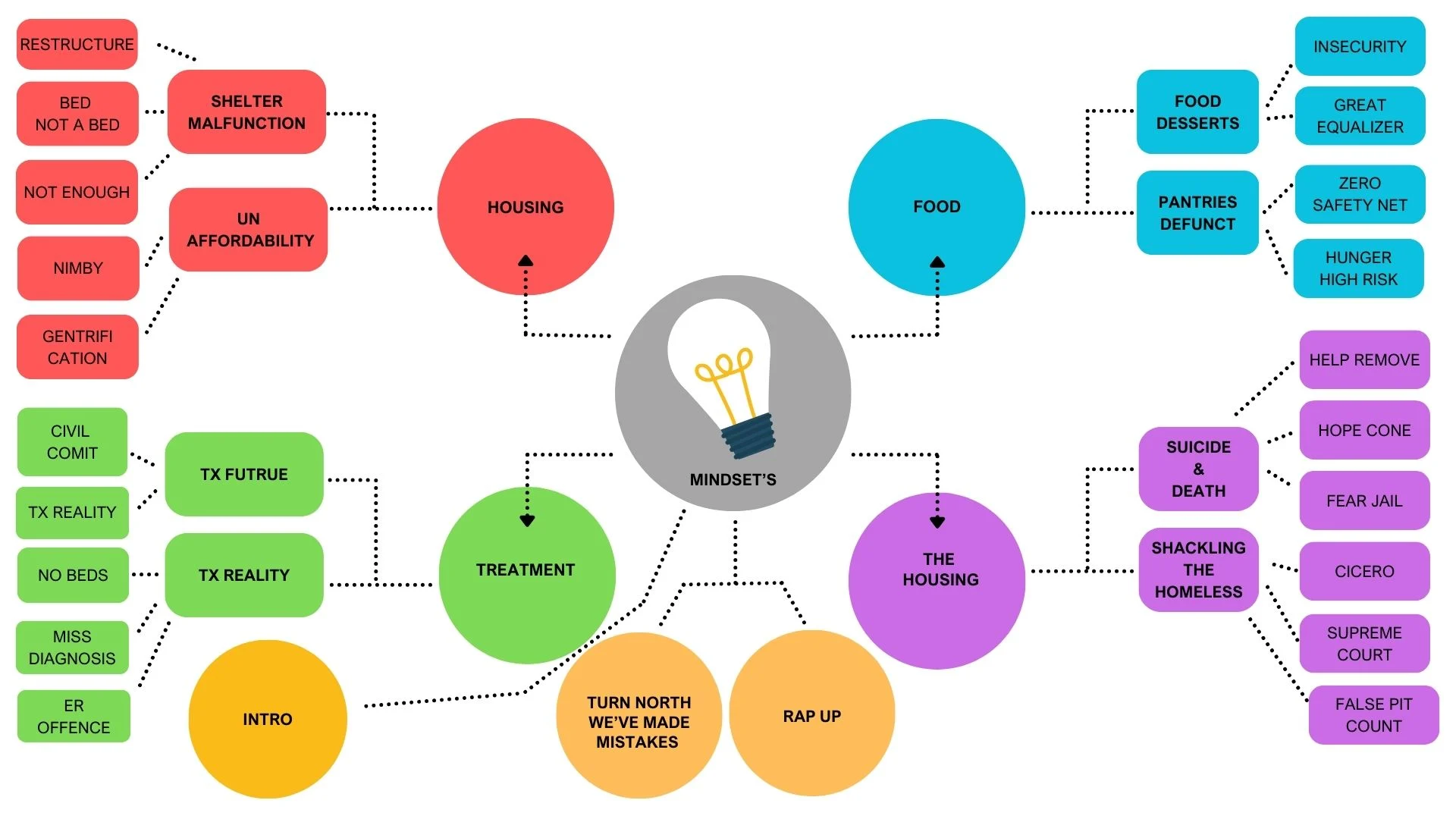
Mindsets Are Ensnaring Tens of Thousands to The Streets
Treatment Reality and Truth
Introduction
Welcome to our second installment in this series dealing with Mindsets and the Homeless. We all have ingrained mindsets, but the process of developing them is unique to each person. However, they are not developed in a vacuum. This is critically true regarding the homeless and the issues regarding the problems they are struggling with presently.
Rarely do we think about the homeless in a manner that has not been influenced by government law, order or sanction. Or even by a Think Tank working with a local government, and all these working together shape our mindset that the homeless are bums, addicts, mentally ill and need nothing but incarceration and no other help than that.
But how does that jive with the disabled, the grandparent, the domestic violence victim, the foster care kid, the one who suffered through a terrible accident and could not recover? Mindsets are powerful and at times dangerous.
Treatment for the homeless, today’s topic, addicted or not addicted, mentally ill or not, what is their current state? Who can tell, for few actually talk to the homeless, they talk about them and around them, making decisions without knowledge. Let’s look at the mindsets regarding addiction and mental illness.

Psalm 10: 17 to 18
Lord, You have heard what the poor people want. Do what they ask and listen to them. Protect the orphans and an end to their suffering so they will not be afraid of evil people.
Lamentations 3: 22 to 23
The Lord’s love never ends, His mercies never stop. They are new every morning; Lord your loyalty is great
Data for this Discussion
First, this is hard to define, differing measurement used in each state and jurisdiction
Single homeless adults range from 25% to 50%
Now, HUD places the numbers closer to 16%
The combination of Mental Health and Addiction is about 67%
Access to Care is Crucial, but lacking
Psych boarding in Emergency rooms is increasing and dangerous
Severe lack of treatment beds for current demands
President’s Memo from this Year
Mental Health rolled into civil Commitment’s
Forced care, off the streets, with the disguise of moral crimes being reduced

What is Addiction
Definition:
A fact or condition of being addicted to a particular substance or behavior
A chronic condition involves seeking and taking substances or performing activities despite negative or harmful outcomes
Nurture or Nature, addiction is not genetic alone nor is it environmental alone. Genetics plays a role in about half of the addiction story, increasing their vulnerability. Genes do not mean that a person will be addicted, but it does mean that one is highly susceptible to that addiction if the circumstances are played out just so.
Judge not lest you be judged, anyone can be addicted to anything. We have just put a microscope on the homeless and their supposed addictions without being willing to understand what they are struggling through. Without compassion and mercy, we can never help a person to overcome any addiction, whether they are homeless or not. Remember this, but for the very grace of God, that could be you or I out there. What has to happen is going to the root cause of the addiction, if there is, in fact, an addiction present.
Where the difficulty enters in with the homeless is here, are they using to escape reality, or are they truly addicted? Review the definitions again and then re-read the question. A person who is trapped on the streets may use alcohol to ease the struggle but put them in a shelter and they no longer use alcohol. True addiction must be determined once a person is safely off the streets, to do anything else adds to the confusion and bias that mark the homeless.

Where do they Go?
The mandate is to remove ‘them’ from the streets,’ take down and destroy the encampments, but where do they go, the unstable, the mentally ill and even the addicted, where? That is part of the issue that no one will answer or give any information about. The name of this game is Hot Potato, no answers, just useless mandates. The Cicero Institution and the President’s Mandate is to get all homeless off the streets, period, no questions asked. But, where do they go, the unstable, the ill, the addicted, the sick and dying, where?
Truth is that the numbers are so uncertain that none can say this is the set and sure number of addicted or mentally ill. However, it is certain that there are not enough beds for them in any treatment facility throughout the United States. Out of a given population group of 100,000 people, there may be a need of 30 to 50 beds at any given time, but there are on average only 18 available.
Currently, emergent boarding is happening at inappropriate facilities, such as hospitals and jails. Slow down before you go and say it is good, they are off the streets, these are not places that are trained for addiction or mental health care. To have the mentally unwell or the untreated addict in their facility is unsafe for staff and other people, but it is now a solution of last resort.

Mental Health is Being Used as a Cloak and Dagger
The few treatment facilities do not openly use cloak and dagger methods, but what happens on the streets and to the at-risk population does qualify as such. The interrelated agencies that work with the mentally ill and addicted do bring about issues and situations that are less than forthcoming and create problems for those in the greatest need of help.
Think of it this way: you are mentally ill, no, you are addicted to a given substance, or no, you are ill, no, it’s addiction that is covering for a mental disorder. How are you supposed to get help if you don’t fit into one of their categories? Since the 1960’s when the mental hospitals started shutting down, the gap was created with little or no treatment facilities. In the same frame of time, substance abuse began to rise, now they are often comingled They are inventing things to make it easier to remove homeless people from society without questions being asked. The cloak, for their good, the dagger, off the streets and out of sight.
The state and federal government do not play fair when it comes to working with or dealing with street-level mental health or addiction and this is one of many reasons we have so many on the streets that are critically ill and will not seek help. It is called fear, they do not want to disappear into the abyss!

Emergency Rooms and Jails Are Not Equipped
With the mental health crisis growing as it is across the board, we do not have to retreat very far into the past to see it. The Pandemic of 2020 and 2021 intensified the need for help and intervention, but there was nothing truly available. Stay in your home, keep your distance, celebrations canceled, families apart, and families kept apart for moments in time throughout the life cycle, created crisis points. The unspoken flip side, medical, clinic workers are quitting at alarming rates, more gaps left open.
The other major component is this: the uninsured or those who lost insurance during the Pandemic. Now I am focusing on the time frame right around the Pandemic, others this would be the length of a novel. Hundreds in need, homeless and not, but resources were not available. What can a person do who may be suffering through any level of mental health crisis and there is no insurance?
This is where the water gets muddy, if there is no money or insurance for the medications ordered by the doctors, what does a homeless person do? They unfortunately turn to street drugs to quiet the voices, the rage, the fear, the constant panic that is raging, what else are they supposed to do?
The person ending up in an emergency room or even in jail during an emergency mental health crisis is the worst outcome that could happen; neither is equipped for the level of care that is needed. Yes, a hospital is great at providing care, but the mentally ill or addicted in a crisis is another dilemma altogether. There is no ability to discern if it is chronic, acute, temporary or whatever; they are not equipped, and the person cannot be helped properly.

What is the End Game, After Treatment
Here is where the hard part starts, what happens after treatment, after the emergency room, after jail? Where do they go? If they are mentally ill, why can they go to get re-stabilized? If they are addicted, when can they go to get off that substance? If they are in crisis, where do they go for the needed help to make it through the crisis in one piece?
Or is the focus only on getting in the front door, because there is no back door? Are there no exit point for those who have entered the front doors?
This is the trick of watching my right, do not bother to think about what my left hand is doing, just watch the right. The right hand in this case is demanding, ordering, and making any stay on the streets illegal, but has no answers as to where they should be staying. After caring for any crisis or stay in jail or a treatment facility, where do they go? There is very, very little transitional housing, what is the next step?
Again, is it a trap or trick, mandate, order, design the laws to get them in the front door, by any means, and don’t worry about after treatment, because there is no back door.
Conclusion
In our last blog installment, we spoke of Mindsets and how they begin, operate, and work to ensnare people to the streets. They are quiet, often subtle and most often than not deadly in nature once fully formed. That sounds like a loaded statement, and it is, because it is truth. Mindsets are neutral until we form them in our own mind, whether for good or evil, but for now, we are focused on the ones surrounding the homeless communities.
A mindset is how we think, act on a given belief, or behave in a certain setting, and they can be powerful, for good or evil. So, there are already certain mindsets formed around and about the homeless community already, and they are not good. Policies, think tanks, mandates, and laws are making sure that the homeless are made to be the bad guy for many things.
Now, if you take the next logical step and take what we studied about mindsets and add the perceived understanding of addiction and illness among the homeless, you have another whole level of deception. Very often you will hear that they are all mentally ill and addicted, that we must be protected from them, that we have t have safe streets and communities. Okay, but what about the humans trapped on the streets because of wrong mindsets, who are just plain vanilla humans that need a helping hand back into life?

CTA…
Please Answer This:
What mindsets have you formed over your lifetime? Long or short, you are forming them from the time you can remember to the present. And they are often not your own. So, what are they and how are they impacting your world and how you view those struggling with addiction?
Please Answer This:
Your thinking, thoughts, mindsets regarding the homeless and their struggles on the streets and going through loss, addiction, mental health crisis, or the like, do you assume it is their fault, or do you think compassionately? Meaning, if they had help, they may not be struggling as they are?
Please Answer This:
Treatment in Emergency Rooms or Jail, without those avenues, where do they go, or does it not matter to you, because it is not you or your family, it is Them? Knowing that there will never be enough beds or spots to care for all who truly need help, does that change your heart at all? Just pause and think, but for the grace of God…

MINDSETS
Manipulated Impartations
Negative Determinations
Seeking Entanglements
Targeting Souls
Why, to control outcomes, decisions, money and lives
For what, to make it easier for the homeless to disappear
How, overwhelm with numbers, anger, frustration, helplessness
Whom, those who are to govern without medaling, but have failed the American people, they created mindsets