



Mindsets Are Ensnaring Tens of Thousands to The Streets
Food Pantries are Defunct Since 2020
Introduction
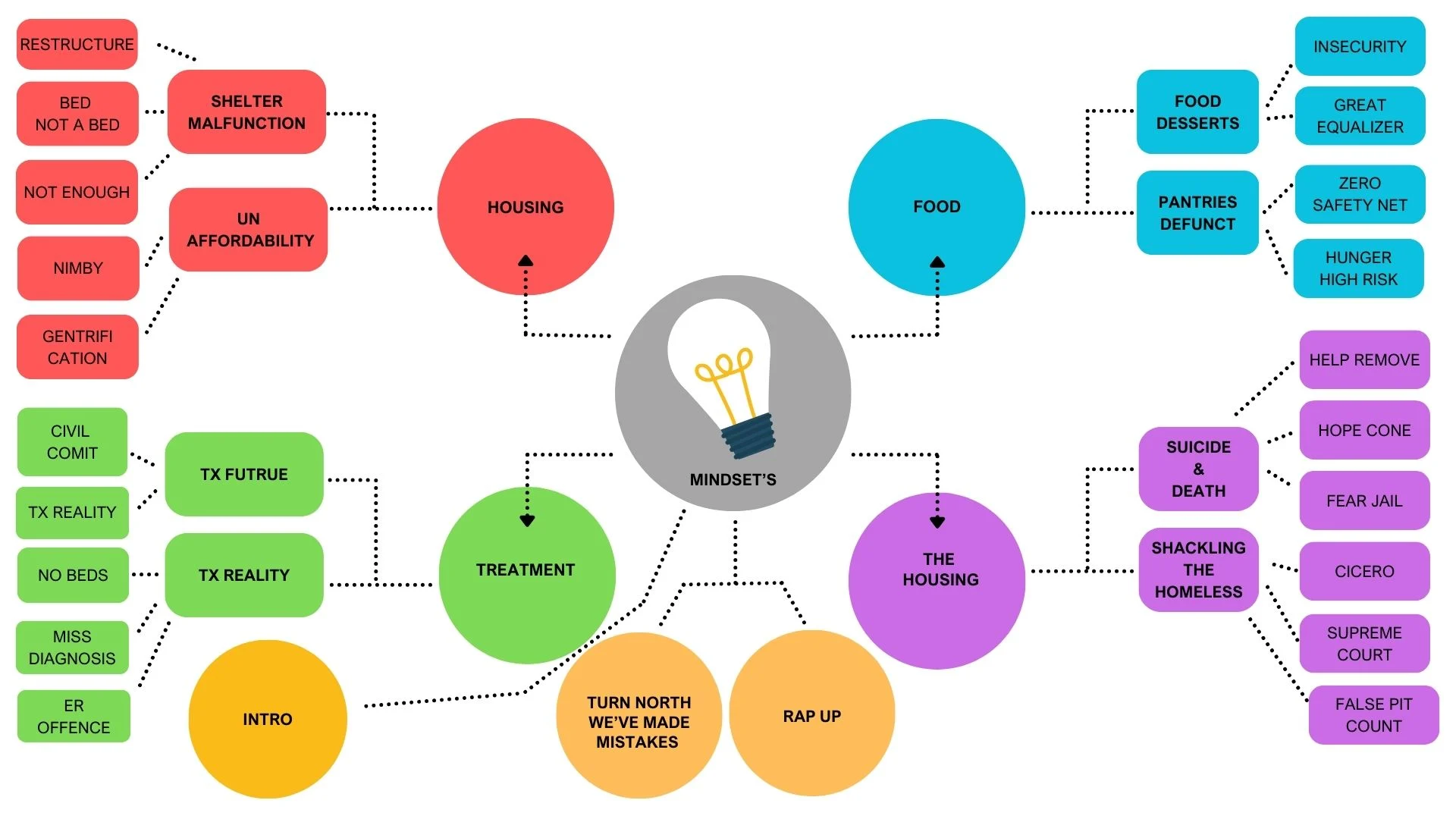
Now we are dealing with mindsets that are being fed with numbers, statistics and information to make us think and form decisions regarding the homeless or the at-risk population a certain way. The Supreme Court has ruled that it is Not cruel nor unusual punishment to fine, ticket, or jail a homeless person even if there are no shelter beds. This ruling has done a great deal of harm to the fight for stability.
A shelter bed is not a shelter bed; it is designated for a male, an addict, a female, or a family, so there are many beds that are empty but not available.
The President’s Mandate carries a serious hidden threat, along with some hope of getting help to the streets for the homeless.
In America, since the great Pandemic of 2020 and the Biden era, the economy has brought a wicked downturn in this nation, the homeless numbers are running just north of 770,000.
The push, the criminalization, and the Cicero led ideas are to just get them off the streets and remove the encampments. Okay, say I agree with that, where are you going to place them? They are humans in need of humane treatment, care and intervention. Where are they going if you do that? It is like the next best crime and punishment novel, a page turner, demands driving the narrative without answers to finish the next page.

An Opening Word
Matthew 14: 17 to 19
They said to Him, we have nothing here, but five loaves and two fish. He said, Bring them to Me. Then He ordered the crowd to recline on the grass., Hand HE took the five loaves and two fish, and, looking into heaven, He gave thanks and blessed and broke the loaves and handed the pieces to the disciples and the disciples gave them to the people.
Ezekiel 4: 17
So they will lack bread and water; everyone will be devasted and waste away because of their iniquity
Data for this Discussion
Cicero Policies and Supreme Court rulings make it hard to Maintain Pantries, complicit in Quality of Life Crimes
Add to the mortality and Morbidity of the street-dwelling people, no food, no health, no well-being
Lack of food can actually start the cycle of homelessness, by ‘cheating the bills’
Adds to the petty crime count locally, steal to eat or drink, not alcohol, food
Most require personal data and info to get any benefits, homeless have lost that info
Due to a shift toward gentrification and a higher socioeconomic population in areas, pantries cannot get permits to operate
Funding and Supply Cuts by the Federal government since the Pandemic have made provisions for the low to extremely low-income population difficult to obtain.

What Was Their Community Role
Let’s take a brief history lesson to start our journey today. Historically, pantries back in the time frame of the Depression were local, community-based based and worked with and from churches. They were stocked with extra local items, foodstuffs from the local communities, and even fresh items from the farms in the given communities. Their intent was simple: to help people get through harsh economic times and hardship within the family unit.
Now, historically, caring for the hungry homeless started with charities and churches. They were soup kitchens and breadlines; we can see this in pictures and movies from the era of the Great Depression. It was focused on immediate relief of the need that person had for food and substance. Then, as the era of the modern food pantry came into being, the system took over, and the ease of feeding the homeless became more difficult. It is called red tape.
Now, in today’s time, to get information on private or charitable pantries is next to impossible. To walk in and just get food is also next to impossible. Our dear Big Brother has gotten involved in every aspect of the Homeless Industrial Complex and demands paperwork, and copies of paperwork, and loves red tape. Most homeless people have lost paperwork in raid after raid or when they go to jail and thus cannot easily fill out the reams of paperwork required for a meal of a simple bag of food. The other aspect of Big Brother handling Food and Pantries is this, they can and do control the narrative.
Who did They Serve
They served the communities, the families, the individuals, and those in need. They were there during those times when the pantry was empty, and bellies were too. Many of the pantries date back to the Great Depression, when food and the money to buy it were scarce, and farms still existed to help families. Just as the bible teaches so clearly, collect the overflow so that those in need would be able to be cared for. But we have strayed far from this principle since allowing Big Brother into the arena of Pantry operations.
Moms, dads, kids, and families served without red tape, without announcing that they were in trouble, quietly, they were taken care of and helped until stability returned; that was the goal. The goal of those that the Pantries served was not lifetime dependence, but a short-term intervention and then a return to independence. That is not how the institutional pantries work today; they give just enough to make them keep coming back and then get them addicted to more help. It is called Generational Poverty.
The bread lines of the Great Depression, the hopelessness of that time to the present, there has always been that group of people through life and its tough situations have needed a hand to make it through, and that group is who the pantries were to serve, but not anymore. Time and again, I have heard of hours that limit emergency relief, restrictions by income, forms that take hours to fill out, community and neighborhood limits, and the like that can tip the scales toward homelessness. In this limited case, we need to reset the clock; it was better when the government was not so involved.

Why Are They Still Needed
Back in time, pantries were for a single home. Then they developed into a communal pantry system for emergency needs. Then, into a system of storage of food and supplies for the needs of the community at large and it was in response to the cuts in the federal government reducing stipends. Now, it appears that pantries are being cut so that the federal government can make the USA a nanny state under its control, because pantries are still needed, but they are doing it totally wrong.
Are pantries still needed is the question; if you look at the numbers presented in the immediate post-Biden era, the answer is yes. Those four years, coupled with the very poor management of the Pandemic, has crippled the average American family and spiked the homeless numbers. It was a set of years where the illegal was more welcomed and cared for than the needy American, and we are still trying to recover. So, yes, pantries are needed, but not in the manner the government is currently running and presenting them.
So, if the answer is yes, Pantries are still, then what do we do in the face of ever-tightening government control over said pantries? That is the tough question: families are in need, school-age children certainly are, and individuals dying on the street truly need more food, but what do we do? We have been so trained to think that it is all pie in the sky roses and puppies right now, and it is okay with everyone, and those in need are actually being cared for. The only ones well cared for until the switch in Washington, DC were the illegals. Please stop believing all that you read.
The Loss of Pantries and the Role of Increased Homelessness
I have a term that I use when working with individuals or families still in homes but struggling with food insecurity, as the government likes to call it these days. I call it, “cheating the bills.’ What is meant by that statement is that they will start cutting back on paying important bills, including rent, to put food on the table. Over time, if not corrected quickly, it will lead to an eviction and the great likelihood of homelessness. This is the gap food pantries are supposed to step into.
So many have closed, streamlined, changed focus, and become unavailable to those in the very most need that it is impacting the homeless numbers locally. The need for food, and food being absolutely essential to life itself, is the great equalizer of life, and if one is hungry, the bills do not matter; a hungry baby or child does. The long-term implications of cheating the bills does not come into sight when food is needed, but quickly homelessness is staring you in the face and often there is no escape.

How The Numbers Have Been Skewed
Let me start with a couple of questions.
First question: if the PIT count is never accurate, how can we ever know how many homeless people need local pantry service?
Second, if there are no statistics kept on non-partner pantries, how can we track the effectiveness or lack of effectiveness of
local pantries?
Next, if forms, documents and data are required for food and the person has lost it, how is the need mitigated with the requirements, or does the person go hungry?
The government has numbers, qualifications, categories, and data to prove or disprove if you are poor, very poor, hungry, or not and if you do not fit in one of those categories, you are out of luck. It sounds harsh, but that is how the government operates, no compassion or mercy, just the numbers please, and nothing else.
It looks at income, population numbers, school data, jobs, businesses, family structure, and other such data to determine if there may be a need in a given community and then they will start the process to send in a Partner Pantry with all the red tape. Meanwhile, the local community Pantries work tirelessly behind the scenes trying to help and ignoring the numbers and data, and often they do not survive.
This is the root birth incentive of this blog series, the number, it is just the numbers! But it is the use of numbers, and the manipulation of those numbers, and the mindsets that are being formed and fed to the American population about what is and is not needed for the at-risk and homeless people in our nation. Until we stop accepting the numbers and believing the numbers and the assumptions connected to them, the homeless population will only grow exponentially.

America No Longer the Great Breadbasket of the World
Coming out of World War 2 and into the 1950’s America could feed itself and a large portion of the world, and hunger was talked about as something in a nation far away. It was a proper sense of pride for the nation. Those who were going through a tough patch knew that they could get the help needed, and food was in abundance. But our friend, Big Brother, got involved in our farming industry, unfortunately. And his dear friend the EPA also joined and has caused great harm to the farms and dairies of this nation.
See, you can either produce food, food products, or dairy products, or you can fight to deal with the rules, regulations, and red tape of the ever-increasing Big Brother syndrome. Family farms could no longer afford to stay in business, affecting local employment numbers. Fish and birds had to be saved, and so regulations were placed on farms and fields so that they were not harmed, but this harmed the food production ability. What was the outcome, less food was available, and what was available was at higher prices. No longer the breadbasket of the world
Conclusion
In this series we are looking at many different topics that all plug into homelessness and what is happening in that world. But not just in that world, it is now moving into our once insular world. We, the housed community, could at one time afford all we needed, and the concerns that produced homelessness did not concern us
Not only is food and access to food becoming expensive, but healthy food is also more difficult to find weekly. Then you add in health care, and other normal life expenses and you will be surprised how quickly that front door could turn into a side, a slide to a homeless shelter
Mental health is more of an issue since the Pandemic, addictions are as well, the ability to a life sustaining job, and the list could go on, but we still blame the homeless person for being homeless, are we still that programed by Big Brother…

CTA…
Please Answer This:
You missed work for a week, illness, no money in the bank, kids are hungry, food is gone, what are you going to do, years ago you would go to a local pantry, but today, what can you do to feed your kids
Please Answer This:
Is the local pantry the problem, or is it the way it is operated and run, is it better to fight for a new operational manager or to close, allow people to be hungry, or clean it up
Please Answer This:
To be hungry, to allow the food desert mindset to grow, the allow the food challenged to be challenged, or is it better to go back to the older times and work to help each other

MINDSETS
Manipulated Impartations
Negative Determinations
Seeking Entanglements
Targeting Souls
Why, to control outcomes, decisions, money and lives
For what, to make it easier for the homeless to disappear
How, overwhelm with numbers, anger, frustration, helplessness
Whom, those who are to govern without medaling, but have failed the American people, they created mindsets